skylar
Sharjah has always been the UAE’s quiet cultural heavyweight. While Dubai grabs the headlines for spectacle, Sharjah quietly invests in craft, heritage, and hands-on creativity. For 2026, the emirate is doubling down on this reputation with a fresh wave of art workshops and craft experiences that go far beyond the standard paint-and-sip evenings. Whether you are an expat looking for a meaningful weekend activity or a tourist wanting to take home a souvenir you actually made yourself, Sharjah now offers some of the most authentic creative sessions in the region.
Sharjah in 2026 is a destination for serious craft lovers. The best art workshops here combine traditional Emirati techniques with modern teaching. You can learn pottery, mosaic, calligraphy, and textile dyeing from master artisans. Most sessions are held in the Heritage Area or at the Sharjah Art Centre. Prices range from 80 AED for a single session to 400 AED for a full-day masterclass. Book ahead for weekends.
Pottery and Ceramic Workshops in the Heritage Area
The Heart of Sharjah is the ideal place to start your creative journey. Several studios here offer pottery wheels and hand-building classes that connect you to the region’s ancient craft traditions. The clay used is often local, giving your piece a distinct sense of place.
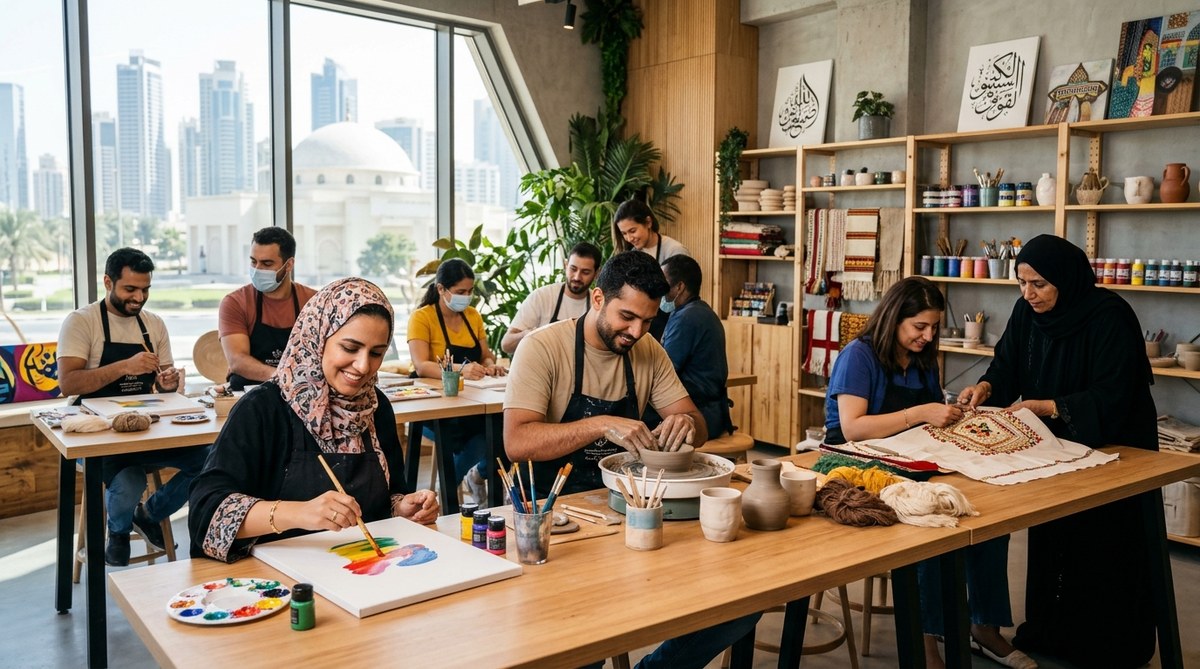
At Al Qasba Arts Studio, the pottery sessions are led by artisans who trained in Turkey and Iran. You can book a two-hour wheel-throwing class for 120 AED. The studio provides all materials and fires your piece for pickup a week later. For those who prefer hand-building, the Heritage Craft Centre offers a three-session course on traditional Emirati water jar making. This is not a tourist gimmick. You learn the actual coiling and smoothing methods used for centuries in the region.
If you are staying in Sharjah for a few days, consider the weekend pottery retreat at Bait Al Naboodah. This restored house in the Heritage Area runs intensive workshops that include a tour of the building’s original well and courtyard. The fee is 350 AED for two days, and you leave with at least three finished pieces.
Mosaic and Tile Art at the Sharjah Art Centre
The Sharjah Art Centre is a sprawling complex that hosts rotating exhibitions, but its permanent workshop space is where the real magic happens. In 2026, the centre has introduced a mosaic tile workshop that teaches the ancient art of zellij (geometric tilework).
This is a four-hour session that costs 200 AED. You learn to cut ceramic tiles, arrange them into patterns inspired by Islamic geometry, and grout the final piece. The instructors are Moroccan and Emirati artists who explain the mathematical logic behind each pattern. You do not need any prior art experience. The centre provides safety goggles and all tools.
What makes this workshop stand out is the setting. The room overlooks a courtyard with a traditional falaj water channel. The sound of running water and the smell of fresh tile adhesive create a focused, meditative atmosphere. Many participants frame their finished tiles and hang them at home.
Calligraphy and Manuscript Illumination
For those drawn to the written word, Sharjah offers calligraphy workshops that are among the best in the Gulf. The Sharjah Calligraphy Museum in the Heritage Area hosts a monthly beginner session led by a master from the Emirates Fine Arts Society.
The session covers the basics of the Diwani and Thuluth scripts. You use a bamboo reed pen and handmade ink. The cost is 80 AED, and all materials are included. The museum itself is worth a visit before or after the class. It displays historic Qur’an pages and Ottoman firmans that show the evolution of Arabic script.
A more advanced option is the three-day manuscript illumination workshop at House of Wisdom. This modern library on the University City Road offers a course on gold leaf application and border decoration. Participants work on a single page over three evenings. The fee is 450 AED, and you leave with a framed piece that could pass for a museum reproduction.
“The best advice I give to beginners is to slow down. Arabic calligraphy is not about speed. It is about breath control and patience. One letter can take ten minutes to form correctly.” — Ahmed Al Suwaidi, calligraphy instructor at the Sharjah Calligraphy Museum.
Textile Dyeing and Weaving Experiences
Sharjah’s textile heritage is often overlooked, but 2026 is the year that changes. The Al Qasimi Textile Studio in the Al Mareija area has launched a natural dye workshop using local plants like henna, indigo, and pomegranate peel.
The session lasts three hours and costs 150 AED. You bring a white cotton scarf or t-shirt, or you can buy one at the studio for 20 AED. The instructor guides you through the process of preparing the dye bath, folding the fabric for resist patterns, and setting the colour with a mordant. The results are surprisingly vibrant. The studio also offers a weaving workshop on a traditional floor loom, but that requires a minimum of four sessions.
For a more immersive experience, the Bait Al Serkhal in the Heritage Area runs a weekend textile camp twice a year. The next one is scheduled for March 2026. Participants stay in a nearby guesthouse and spend two full days learning silk painting, embroidery, and natural dyeing. The cost is 1,200 AED including accommodation and meals. Spaces are limited to twelve people.
A Practical Guide to Booking Your Workshop
Booking an art workshop in Sharjah is straightforward, but there are a few details to keep in mind. Use this numbered list to plan your visit.
- Decide on your medium. Pottery and mosaic are the most popular, so book at least two weeks in advance for weekend slots. Calligraphy and textile workshops have smaller class sizes but are easier to join on weekdays.
- Check the location. Most workshops are in the Heritage Area or near University City. If you are coming from Dubai, allow 45 minutes to an hour for the drive. Parking is available near Al Qasba and the Souq Al Arsah.
- Bring the right clothing. Pottery and textile dyeing can get messy. Wear closed shoes and clothes you do not mind staining. The studios provide aprons, but they do not cover everything.
- Confirm the language. Most instructors speak English, but some older artisans prefer Arabic. If you are an expat, ask when booking if an English-speaking assistant will be present.
- Plan for pickup. If you are making pottery or mosaic, the piece needs to be fired or grouted. This usually takes a week. Studios can ship within the UAE for an extra fee, but international shipping is not always available.
Comparing Workshop Types: Which One Suits You?
Different workshops suit different personalities and skill levels. The table below breaks down the key factors to help you choose.
| Workshop Type | Duration | Cost (AED) | Skill Level | Best For |
|---|---|---|---|---|
| Pottery (wheel) | 2 hours | 120 | Beginner | Hands-on learners who want a physical souvenir |
| Mosaic tile | 4 hours | 200 | Beginner to intermediate | Pattern lovers and geometry fans |
| Calligraphy | 2 hours | 80 | Absolute beginner | Those interested in Arabic culture and history |
| Textile dyeing | 3 hours | 150 | Beginner | Eco-conscious creatives and fashion enthusiasts |
| Manuscript illumination | 3 evenings | 450 | Intermediate | Detail-oriented artists with patience |
A common mistake is to assume that all workshops are drop-in friendly. They are not. Many require pre-booking and a minimum number of participants. If you are a solo traveller, call ahead to confirm that the session will run. Studios sometimes cancel if fewer than three people sign up.
Why Sharjah in 2026 is Different
Sharjah has always had a strong arts infrastructure, but 2026 marks a shift toward participatory culture. The emirate is no longer content to be a place where you look at art behind glass. It wants you to make it. The workshops listed here are not afterthoughts. They are curated experiences backed by the Sharjah Institute of Theatrical Arts and the Department of Culture.
For visitors, this means you can spend a morning learning a craft that connects you to the region’s history, then walk through a nearby souq and see the same techniques applied in the goods for sale. The loop from learning to observing to buying creates a richer travel experience.
If you are planning a longer stay, consider pairing a workshop with a visit to the Many of the studios are within walking distance of the major museums and galleries. You can easily fill a full day with creative activities without ever getting in a car.
Your Next Creative Outing Starts Here
The best art workshops in Sharjah for 2026 are not about perfection. They are about process. You will not become a master potter in two hours, but you will understand why the clay feels different in your hands than it does on a video. You will not write like a calligrapher after one session, but you will feel the weight of the reed pen and the patience it demands.
Pick the workshop that calls to you. Book it. Show up with an open mind and clothes you can get dirty. The studios in Sharjah are welcoming, the instructors are generous with their knowledge, and the city itself provides a calm backdrop that lets you focus. Whether you are a resident looking for a new hobby or a tourist seeking a meaningful memory, these craft experiences offer something you cannot buy in a shop: the satisfaction of making it yourself.
Go ahead. Get your hands in the clay. Your 2026 Sharjah story is waiting to be shaped.